KNVB Account
Log in met je KNVB Account of maak een nieuw KNVB Account aan.

It is not possible to load the page you were looking for on KNVB.com.
The website is currently in maintenance mode. Please try again later.
Do you use an adblocker? Try turning it off and reload the page.
Log in met je KNVB Account of maak een nieuw KNVB Account aan.

KNVB.nl
News and support for Dutch football.

Oranje
The official channel of the KNVB for all Oranjefans.

Voetbal.nl
The platform for results, standings, programs for all amateur football players in The Netherlands.

TOTO KNVB Beker
The latest news, results and programs of the TOTO KNVB Beker.
Azerion Vrouwen Eredivisie
The official channel of the Pure energie Eredivisie Vrouwen with the latest news, programs standings and rundows.

Rinus
The online assistant for all youth trainers of The Netherlands.

KNVB Shop
The offical webshop of the KNVB.

KNVB Ticketshop
The Offical sales channel for the KNVB. Buy your tickets here for Oranje and the TOTO KNVB Beker.
Foto: KNVB Media
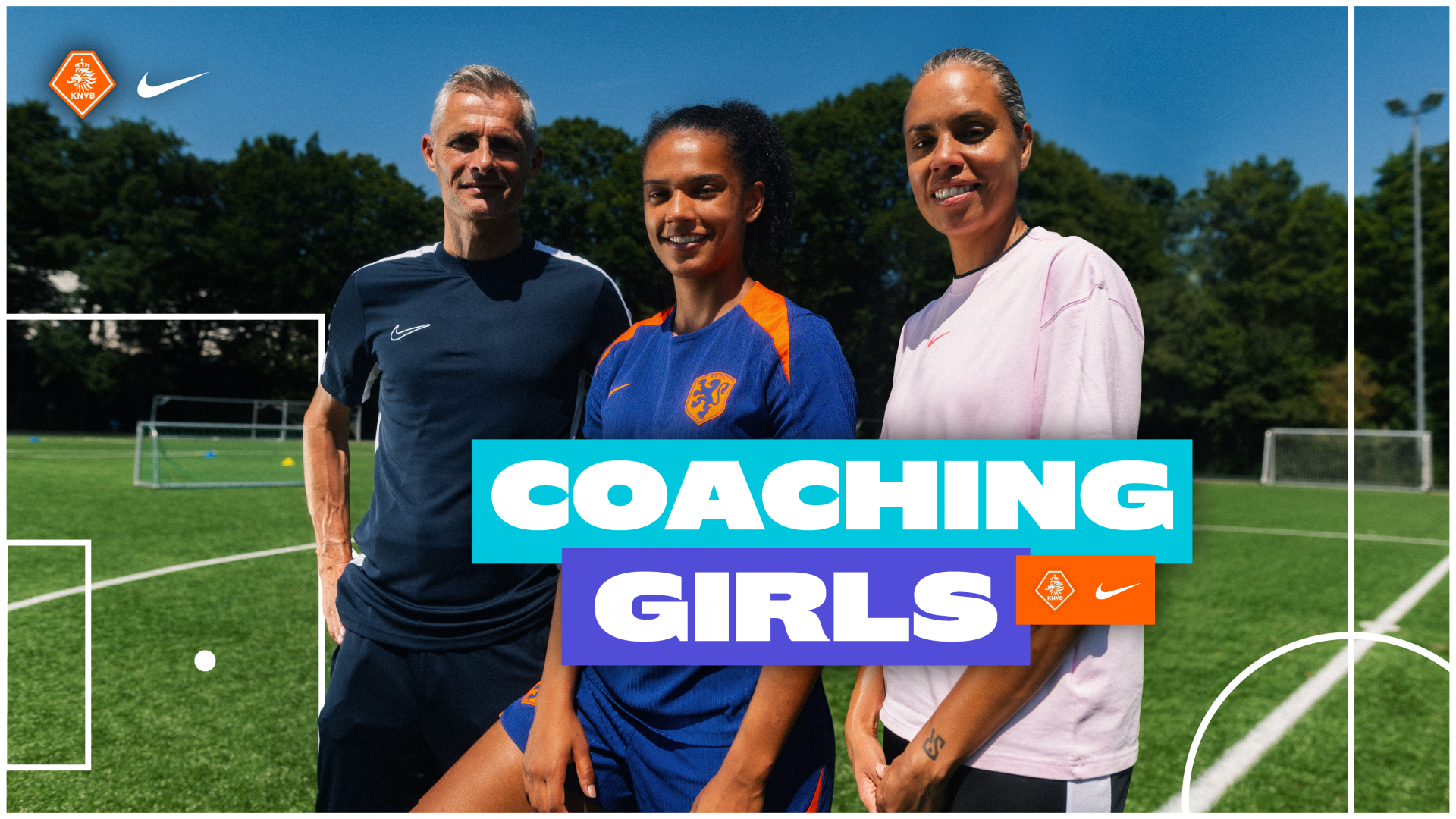
Despite a growing number of teenage girls playing football in the Netherlands, dropout rates remain higher than among boys. Addressing this challenge is the focus of Coaching Girls, a programme developed by Nike and the KNVB to support coaches of girls’ and mixed teams.
Dan Burrows, GM Future of Youth Sport and Senior Director of EMEA Social & Community Impact at Nike, has been closely involved in the initiative. With years of experience at the intersection of sport and social impact, he sees coaching as a decisive influence on whether young athletes feel welcome, supported and motivated to stay in the game.
While the number of girls aged 13 to 18 playing football in the Netherlands continues to grow, dropout rates in this age group remain significantly higher for girls than for boys. Social norms, stereotypes and coaching approaches that are not adapted to girls all play a role. Puberty marks a phase in which physical, mental and social differences between boys and girls become more pronounced, requiring different knowledge and skills from coaches.
This is where Coaching Girls comes in. The learning module is specifically designed for coaches of girls’ and mixed teams and offers guidance across fourteen themes that are particularly relevant to girls in football. Topics range from giving feedback and dealing with conflict to setting goals and addressing menstruation. Clubs also receive practical advice on facilities, such as changing rooms, club kits and other provisions that can make a real difference in whether girls feel welcome and comfortable.
Nike and the KNVB have worked together for nearly 30 years and, according to Burrows, increasingly recognise football’s potential as a tool for lasting social impact. Inclusion, he emphasises, is central to great coaching. “Through inclusive coaching, more young people can feel like they belong in sport. Especially for girls, that sense of belonging isn’t always a given.”
Dan Burrows.
The impact of Coaching Girls is already visible. The programme won a social impact award and received an overwhelming response after launch. In its first year, more than 2,600 coaches ordered the booklet and over 1,000 attended physical workshops. Notably, 85 percent of participating coaches indicated they wanted more support. “To us, this underlines the need and the interest,” Burrows says.
The second year therefore focused not only on reaching new coaches, but also on staying connected to those who asked for continued guidance. “Winning a prize is great recognition for the hard work of the team, but it doesn’t stop there. The end goal is that all young people have a great coach in their corner, someone who inspires a lifelong love for sport and helps make athletes dreams real.”
The collaboration between Nike and the KNVB goes beyond a single programme. “What makes this collaboration unique is that our shared ambition is bigger than the KNVB or Nike,” Burrows says. “If we want to be the biggest champion for women and girls in football, we need collective action.” This philosophy translates into concrete action, such as a Nike-organised summit in Switzerland where federations shared insights on increasing female coach representation across Europe.
Looking ahead, there are still clear ambitions. Most participants in Coaching Girls are men, reflecting the reality that many teams are coached by men. At the same time, Nike and the KNVB are determined to change the face of coaching itself. “Together with the KNVB, we want to strive for more female coach representation in football. We want to recruit and train more female coaches, because we firmly believe: if she can see it, she can be it.”